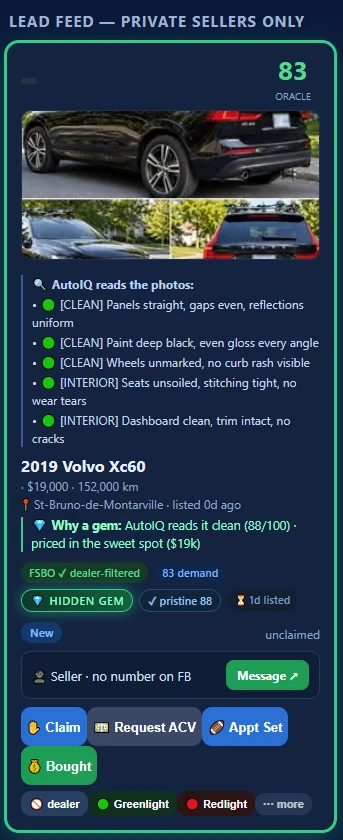
- CLEANPanels straight, gaps even, reflections uniform
- CLEANPaint deep black, even gloss every angle
- CLEANWheels unmarked, no curb rash visible
- INTERIORSeats unsoiled, stitching tight, no wear tears
- INTERIORDashboard clean, trim intact, no cracks
Every one of them comes out — then we read every photo the seller posted, before your buyer ever picks up the phone.
Marketplace fights you on purpose. It buries the listing detail, hides the gallery, and mixes the dealers in with the real people. We got past that. Your board is the part that's left: real private sellers, graded, ranked, and waiting when you walk in.
We don't sell you leads to chase. We tell you which cars to avoid — and which ones are the cream puffs.
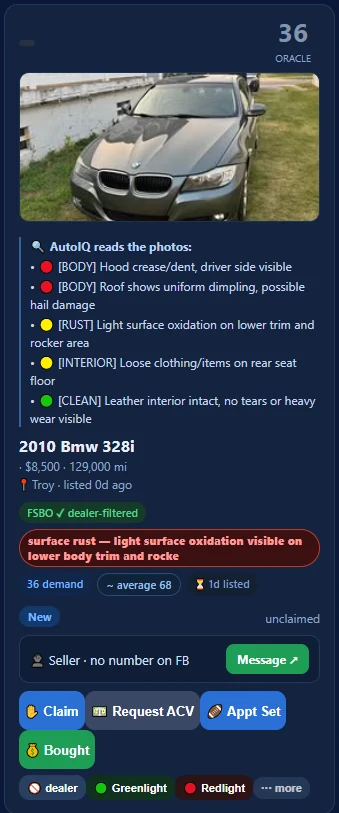
Screenshots straight off a live board — not mockups. Same sweep, same morning. The difference is what the photographs gave up — and neither ad said a word about any of it.
Hail dimpling across a roof. A crease in a hood. Rust starting on a rocker. Your buyer would have driven to Troy to find that out.
A dealer posing as a private seller doesn’t say so in the ad. He gives himself away in his own photographs — and our vision engine is looking at the whole picture, not just the car in it.
When it catches one, we don’t just skip that listing. The seller is barred. Every car he posts after that is gone before it ever reaches your buyer’s board. Your floor never calls him, never drives out to him, never loses another morning to him.
Every other tool in this business will tell you it filters dealers. Ask them what happens the second time.
Ask a room of dealers about Craigslist and half of them will tell you nobody uses it anymore. They’re wrong, and it’s costing them cars.
One pass, and 99 out of 100 came back with a real odometer reading. A Craigslist post carries more than a Marketplace post does — the full gallery, the mileage, often the VIN and the title status right on the page. It’s still full, and almost nobody is looking.
Neither is the store down the street from you.
Anybody can pull a list of cars. The signal that matters is demand — and every car gets a demand score that bakes in the two reads a 30-year buyer makes on instinct: how hot it is in your market, and how motivated the seller is. That brain lives in the cloud.
Every private-party car we pull gets read against what's actually selling in your market — not a national average. Your buyer sees what's hot where you sell, today.
Private sellers ask high. A thin spread isn't a miss — it's the signal. And a car that's sat 10+ days is a seller getting ready to deal. We surface that, because a 30-year buyer reads it on instinct.
The judgment that takes decades to build — what's worth chasing and what's a trap — runs as the brain behind the board — thirty years of buying encoded, and it's patent pending. That's the part a software startup can't copy. They don't have the eye.
AutoIQ is the separator. Our vision engine reads the listing's photos the way you read the row — the full gallery on both sources, Marketplace included — flagging dealer cars and grading condition off what the seller actually posted, and telling you straight when a picture won't support a call. The feeds only read the words. AutoIQ reads the car.
AutoIQ reports only what the photos prove — and says “not assessable” before it ever guesses. No invented tread depth, no phantom mileage, no “probably.” If we can't prove it from the picture, we don't say it — because if we tell you the tires are shot, we'd better be able to show you.
While everyone else begs the public to sell them a car, AutoIQ goes the other way — it hunts the right private-party cars at the right moment, reads every photo like a 30-year buyer, and puts the cream puffs on your floor before the other guy even wakes up.
A Marketplace post is often a price and three words. No mileage, no VIN, no title status — and a car with no odometer on it is a car your buyer can’t put a number to. So we don’t wait for the seller to type it. We open the listing itself and pull the odometer, the VIN and the title status off the page. Last night that came back on 99 out of every 100 cars we pulled. The feeds hand your buyer a blank mileage field and still call it a lead.
The clean, well-kept, in-demand car from a private seller who's ready to deal — buried under a three-word post and one dark photo. The other tools never see it; they only read the words. AutoIQ reads the pictures, sees the car for what it really is, and floats it to the top with a 💎. That's the one you buy before the other guy even knows it's there.
We're not vAuto — keep your number. Your buyers already trust it, and they should. Auto Oracle just makes sure they only spend it on cars worth buying — not the morning burned on stuff that was never desirable.

Facebook Marketplace and Craigslist — your whole market, all day. U.S. and Canada.
AutoIQ reads the photos — stock shots, dealer lots, plate frames — to catch the dealer cars text alone misses. What's left is real private sellers.
Each car scored by the demand index + the motivation tells, so the best of them rise to the top.
It all lands on your buyer's board — claimed, called, and worked from one screen.
This isn't a list you dig through. It's what turns one rooftop into a buying center — the whole floor claiming, calling, and closing off one board. The working-the-lead discipline I've built over and over, baked in. Open it at 9, work it till close.
No scrolling, no 50 open tabs. Today's private-party cars in your market are already scanned, filtered, and ranked waiting on the board.
Your buyer claims the cars worth the call. First to claim owns it — no two buyers calling the same seller, no stepping on each other across rooftops.
Call, text, work the deal, move it down the pipeline — all from the card. The good ones go fast; you're there first, not the third dealer to call.
A claimed lead that sits unworked gets flagged and surfaced back up. No car dies in somebody's inbox. The manager sees who's working and who's sitting.
Your buyer brings you the desirable ones — the cars worth owning — instead of a pile to sort through. Pull vAuto on the handful that matter, not the whole morning. The store buys more off the street, cheaper than the lane.
This wasn't built in a sprint by people who've never bought a car. Every read in it is a call a real buyer has to make — not a guess from someone who's only seen the spreadsheet.
We don't replace your tools. Put your stretch number on it and hit save — same tool, same you. We just make sure it's a car worth it — dealers and junk stripped out before your team ever signs on.
I've spent thirty years learning which car at which number actually makes money. I put it in a tool — for the old dogs who don't have time to scroll, and the new generation that never got to learn it.
To the old dogs: you already know the good metal left the lane and it's sitting in driveways now. You don't need me to find it — you need to get there first, without living on your phone. This does that.
To the new generation: you've got the instinct for Marketplace. What you haven't built yet is the eye for what's really worth chasing. I built mine in — so you don't learn it the expensive way.
And it runs on the BDC culture I've built and rebuilt my whole career — every lead claimed, every seller called, nothing dropped on the floor. The feed is the easy part. Making sure your people actually work it is what puts cars on the lot. That's what the other guys don't sell you. That's what you're paying for.
I've run a desk by myself for a week straight. If I'd known every car my buyer set in front of me was already the best of the best — dealers stripped out, junk gone, only what's worth my time — I'd have dropped everything. That's what this is.
No per-car fees. No per-lead fees. No per-seat tax. If it doesn't put cars on your lot, you shouldn't pay for it — so you don't.
Tell us where you sell — we'll show you the private-party cars sitting in driveways around your store right now. A car guy reaches out personally.